EVAP's Free-Trade Filter Keeps Chinese EVs Out
The January tariff deal with China got the noise: a drop from 100% to 6.1% on Chinese-built EVs, a rising five-year import cap starting at 49,000 units, and weeks of editorial hand-wringing about whether Mark Carney had sold the farm.
The January tariff deal with China got the noise: a drop from 100% to 6.1% on Chinese-built EVs, a rising five-year import cap starting at 49,000 units, and weeks of editorial hand-wringing about whether Mark Carney had sold the farm (Electric Autonomy). The deal took effect March 1, 2026 (electrive). But the tariff is only the first gate. The second gate, quieter, stricter, and structurally more decisive, opened two weeks earlier when the Electric Vehicle Affordability Program became law on February 16, 2026 (Electric Autonomy, CBC News). EVAP offers rebates on new battery electric, fuel cell electric, and plug-in hybrid vehicles (Electric Autonomy). It also contains two rules that together decide where the money flows: a $50,000 transactional price cap for most vehicles, and a free-trade-country manufacturing requirement that excludes Chinese-built EVs entirely (Electric Autonomy, Drive Tesla Canada).
Which vehicles clear the $50,000 threshold?
The cap isn't calculated on base MSRP. Under EVAP, the final transactional value includes manufacturer's suggested retail price, factory add-ons, dealership accessories, and fees, but excludes warranties, insurance, tires, aftermarket chargers, and taxes (Electric Autonomy). That's narrower than the prior iZEV program. A buyer who adds paint protection, roof rails, and upgraded wheels at the dealership now risks pricing themselves out of the rebate before signing. The part worth paying attention to is the inclusion of factory add-ons: option packages chosen at order freeze the transactional value before the dealership touches the car. A Model 3 Long Range with premium paint and 19-inch wheels might clear $50,000 before delivery fees; the same configuration in Performance trim does not.
Canadian-built EVs bypass the cap completely
EVAP exempts vehicles built in Canada from the $50,000 threshold (Electric Autonomy, Electric Autonomy). Any vehicle assembled in Oshawa, Oakville, or Windsor qualifies for the full BEV rebate regardless of transaction price. The exemption doesn't name automakers or assembly lines, but it structurally rewards domestic production without saying so in the preamble. Read it straight: the policy creates a price ceiling for imports and no ceiling at all for Canadian assembly.
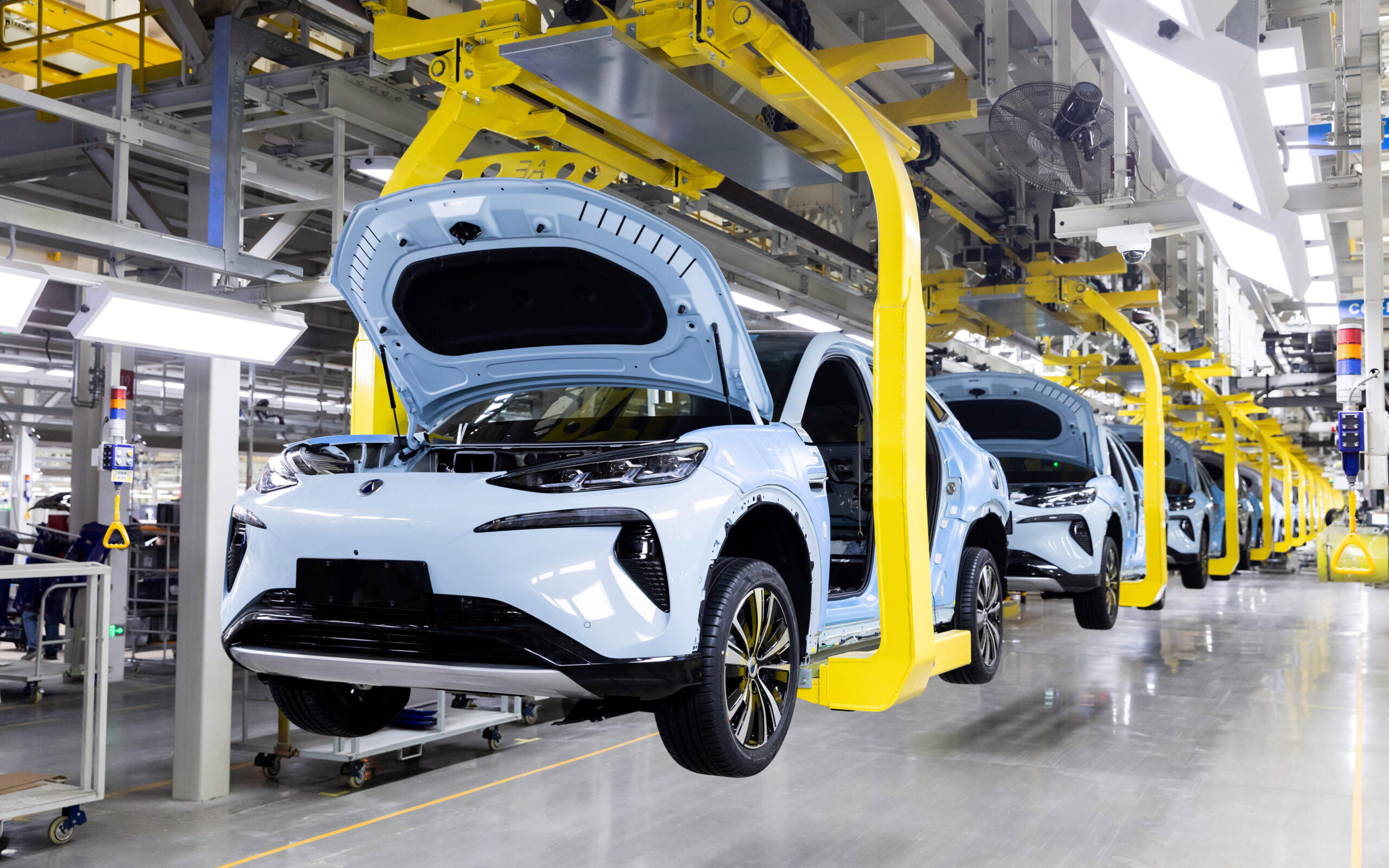
Chinese-built EVs like BYD can enter Canada under the January tariff quota but don't qualify for the EVAP rebate. Photo: Electric Autonomy Canada
Why don't Chinese EVs qualify for the rebate?
EVAP requires eligible vehicles to originate from countries with free-trade agreements with Canada (Electric Autonomy, Drive Tesla Canada). China is not party to a bilateral or multilateral free-trade agreement with Canada. No BYD Seal, no Zeekr 001, no MG4 built in Shanghai clears the rebate gate, regardless of sticker price, regardless of whether it arrives under the January tariff quota. A Chinese EV landing in Vancouver in April 2026 pays the new 6.1% tariff but receives no federal rebate, while a Korean-built Hyundai Ioniq 5 pays the same duty rate under Canada-Korea FTA terms and qualifies for subsidy if it stays under $50,000 transacted. The structural outcome: Chinese automakers can access the Canadian market under quota, but cannot compete on subsidy-adjusted price.
The tariff and the rebate work as paired gates
What's structurally true here is that neither gate alone achieves full exclusion. The tariff sets a volume ceiling and a per-unit cost; the rebate creates a price disadvantage that compounds at point of sale. The policy doesn't ban Chinese EVs outright. It makes them uncompetitive in the price segment where federal subsidy defines buyer decision-making. That's a different kind of protection than a tariff wall, and it runs through 2031 with a $2.3 billion budget targeting more than 840,000 rebated vehicles (Electric Autonomy).
How does EVAP reshape the broader EV policy package?
EVAP didn't arrive alone. On February 5, 2026, the federal government repealed the Electric Vehicle Availability Standard, which had required automakers to hit 20% zero-emission vehicle sales by 2026, 60% by 2030, and 100% by 2035 (Electric Autonomy). The replacement regulation sets greenhouse-gas-based targets of 75% EV sales by 2035 and 90% by 2040: a slower ramp, a longer runway, and room for plug-in hybrids to count toward compliance in early years (Electric Autonomy). Prime Minister Carney framed the package as one aimed at building the affordable, low-emissions automobiles of the future through strategic decisions and generational investments (Electric Autonomy). Daniel Breton, President and CEO of Electric Mobility Canada, has argued that previous U.S.-aligned emission standards failed miserably, citing a 1% reduction in Canadian fleet emissions between 2011 and 2023 as justification for independent standards (Electric Autonomy). What emerges from February 2026 is tariff quota, rebate filter, and relaxed sales mandate. The tariff caps Chinese volume; the rebate caps Chinese price competitiveness; the softened mandate gives Detroit and its Canadian plants breathing room to ramp EV assembly without meeting the old 2030 cliff. It's protection through subsidy design, not just border duty.
How will Canada's EV subsidy cycle end?
EVAP steps down annually: the BEV rebate drops from $5,000 in 2026 to $4,000 in 2027, $3,000 in 2028–2029, and $2,000 in 2030; the PHEV rebate follows the same cadence from $2,500 down to $1,000 (Electric Autonomy). The program sunsets March 31, 2031 (Electric Autonomy). By then, the policy assumes that domestic battery plants in Windsor and Bécancour will be online, that assembly capacity in Oshawa and Oakville will have absorbed EV line conversions, and that Chinese automakers either will have negotiated new terms or accepted niche status in a market where subsidy access defines affordability. The declining rebate is a countdown clock, and the free-trade filter ensures that when the rebate reaches zero, the vehicles that benefited most will have been built on this side of the Pacific.
Ready for Professional Car Care?
Experience the Sahr, Rhymes with Car difference — mobile detailing that comes to you.
Book NowRelated Articles

Alberta's 2026 Insurance Grid Is a Sorting Mechanism
Alberta's grid base premium rose 20% on January 1, 2026, per a decision issued by the Alberta Automobile Insurance Rate Board on September 26, 2025. ([Armour Insurance](https://www.armourinsurance.ca/blog/alberta-auto-insurance-grid-20-percent-increase-2026), [AIRB](https://al...
Capital Exodus and the Car You Already Own
Roughly $1 trillion in investment capital has left Canada over the decade from 2015 to 2024, according to RBC analysis cited in Canadian business press (We

Sherwood Park Is the Edmonton-Area Car Town Nobody Writes About
Thirty-three years of organized car shows. A dealership running Cars & Coffee all summer. A custom shop with a burnout competition. And zero editorial coverage — until now.